Tuesday, October 12, 2021

Secrets of Krakow with a little thrill

 It happens that we find ourselves in a place completely by accident, completely unaware of the treasures of history hidden there. However, there is something in them that somehow attracts us. Do you know where mummified bodies are located in Krakow? How to enter the shelters in Nowa Huta? Where was the best bar in the Middle Ages? I invite you for a walk through some mysterious places. I am going to share with you stories that make your skin go chills and make your heart beat faster. They say that each city has its secrets, the roads to which are usually unknown to tourists eager for new interesting knowledge and curiosities. Secret places will be hard to find on the map, and in order to discover them, you have to start searching and explore the city with greater care. Let this short guide be a clue that will help you discover at least some of Krakow's secrets during your next visit.

Knife in the Sukiennice: One of the popular Krakow legends is associated with this knife. When walking through the center of the Cloth Hall (eg going from ul. Szewska to the monument of Mickiewicz), a knife hangs on one of the walls, at the very entrance. How did he get there? This legend circulates in several versions - I will tell the darkest one. Apparently, the knife hung in the Cloth Hall to warn people, reminding them of the law in force - according to the Magdeburg law, the penalty for theft was cutting off the ears.

Only a randomly met person, in a short chat, will discover strange secrets and secret places not intended for masses of tourist trips. This is often the case in Krakow, a city that would seem to be trampled underfoot by amateurs of cheap beer and cursory inspections. Winter is a time of silence and contemplation. Especially in the morning, Krakow becomes a magnificent castle that an attentive tourist can admire in delight and tranquility. This text is unusual. Due to the dark subject matter, you will find many unknowns in it. I hid "secret passages" in the entry, which will lead you to additional places and intriguing information. I wonder if you will find them ...

How will you react when I tell you that there are underground crypts in Krakow in which over 1,000 people are buried? What if I add that they have a natural microclimate, which meant that the bodies of the dead were preserved in a very good condition? We are talking about the catacombs at the church of St. Kazimierz Królewicz at ul. Reformed. The dead from 1672 were buried in underground crypts. Some of the coffins are covered with glass lids. This place is not open to the public on a daily basis. Until now, the crypts were opened only on November 2 - on All Souls' Day. Unfortunately, this year the monks decided not to open the catacombs. Of course, this place cannot be treated as a tourist attraction, but the history itself is interesting and worth knowing.

Reformacka Street is hidden quite carefully from trips, although it is not far from Market Square. Time stood here centuries ago and having wandered around here, it is hard to believe that the 21st century is vibrant with life behind a few blocks. Even better, the tiny church of St. Casimir the Prince. He is a Polish Jagiellonian, son of Kazimierz IV Jagiellon, patron of Lithuanian and Polish youth, an extraordinary figure. He was one of the numerous siblings: 7 brothers and 6 sisters. Educated by Długosz himself, at the age of 13, he led 12,000 soldiers to the war to regain the Hungarian crown. The expedition failed and from that moment on, the Prince, deeply sensitive and intelligent, did not undertake any major undertakings. He writes: "The ruling of the kingdom of great wisdom needs and heavy account before the Lord God of this ruling." This should make him a patron of all politicians, because for a few of the power is associated or associated, mainly with responsibility. For some time the prince rules very prudently and fairly in Radom, then, suffering from tuberculosis, he leaves for Lithuania. There, he lives a simple and austere life, in piety and chastity, and dies at the age of 25, already surrounded by a halo of holiness during his lifetime. A modest church in Krakow would surely appeal to the Prince. Built-in 1666-1672, it is a typical model of a reformatory temple (the then Franciscan faction). Above the entrance, there is an image of the patron, and if we look a little further along with the monastery building, we will see an extremely rare, small "bell for the dying" under a wooden roof. It was called when someone close to you was dying. The single-nave church is dusk with scattered chiaroscuro playing on gilded, baroque ornaments. According to the Reformed principle, a magnificent crucifix is ​​placed on the altar. And only the initiated know that an extraordinary phenomenon is hidden here: hundreds of extremely well-preserved mummies of people buried in the church cave-crypt since 1667.
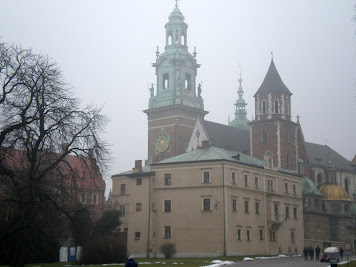
The crypts are basically forbidden, and they are not a tourist attraction announced in guidebooks. Just like to ensure the peace of the dead, as well as to protect the delicate atmosphere of the rock cave in which it is located. Only on November 2 and 3, they are open to outsiders. However, if we really care, we can ask the porter and support his request with the motivation to contribute to the maintenance fund. They don't usually refuse unless it's mainly to satisfy empty curiosity. The secret of such perfect mummification, without any chemicals, is explained by scientists by the specific microclimate of the grotto. However, how it was created, and how exactly the same air humidity has been preserved over the centuries, remains a matter of guesswork. The entrance is in the main nave of the church. Just a few steps down will lead us to an unusual grotto crypt. From the very beginning, members of the mighty families of Wielopolski, Szembek, and Morsztyn were buried there. The monastic books indicate that almost a thousand people are buried there: 730 lay people and 250 religious brothers. Only about 50 mummies are on display. In the coffins covered with glass lids, we can see extremely well-preserved figures, in period costumes that should have disintegrated a long time ago. Only the mummies of the religious brothers, still in the same habits, lie directly on sand and rock. Even the facial expressions, the hair color, are still visible. Each of these characters has a story.

One of those buried in the crypt is Daniela Skalska, who appeared in the church out of nowhere. For 20 years she made church vestments and cleaned. It was only on her deathbed that she confessed (she died in 1864) that she came from a powerful family. Next to her is a Napoleonic soldier in full uniform. He, too, appeared seriously wounded at the convent's gates in 1812 and died there. Apparently, it was Daniela's great love, for which she ran away from home and with which she decided to stay. There is also a young woman in a gorgeous wedding outfit with an equally sad story. Apparently, she was poisoned on her wedding day by her father, who could not bear the mesalliance, and gave her poison in the wedding wine to "save the honor of the family". Perhaps these stories are just legends, perhaps they are true: the monks carefully guard the privacy of their unusual tenants. A little further there is the "Niche of Death", a crypt with the bodies of monks covered with limestone pieces of rock. Supposedly, the brothers who were feeling death brought these stones from the Silver Mountain to serve as penitential "pillows". On the other side of the street, opposite the church, there is an interesting Way of the Cross, built in the form of chapels from 1814-1816. It used to be a cemetery there. The stations have deep recesses with pictures painted by Michał Stachowicz. They are opened during the celebration of services. Just like the whole modest Reformacka Street, and the place where time really stopped in a strange grotto.

Nowa Huta is one great mystery - a city built from scratch according to a specific plan. Looking at this district from a bird's eye view, you can see the non-accidental layout of streets and neighborhoods. In my opinion, it is a small urban masterpiece. Much is said about the bunkers in the area of ​​Nowa Huta. It is said that in one of the newest districts of Krakow - Nowa Huta, there are shelters in most of the buildings. There would be nothing extraordinary about it, if not for the fact that all of them were once to be connected to each other, creating something like an underground city for residents in case of an emergency. Today, three historical sites are available to visitors - the Command Center in the Kombinat building, a shelter in one of the buildings, and the underground of the former Światowid cinema. All of them are in excellent condition, and being in the area it is worth going and seeing some elements of the unfinished underground city with your own eyes. Apparently, most of the buildings contain shelters that were to be connected with each other, creating an almost underground city. Yes, shelters were planned in many of the buildings there, but from the very beginning, there was a lack of financial resources for their construction. According to reports from the 1970s, the bunkers were already in poor technical condition, some of them were not finished, and there was also a lack of equipment. In short: today they would not be able to fulfill their functions. Command Center in the Combine building. The facility is in excellent condition. In the event of an emergency, people responsible for the rescue operation and supervision of technological processes were supposed to stay in the shelter. The bunker consists of several rooms and is fully equipped. Anyway, look at the photos! Shelter in the Z building. Another place in the Combine building, which is available to visitors. The bunker was prepared for the employees of the Administrative Center, then underwent partial modernization, which was to adapt it to the hazards associated with the atomic bomb. You can visit these two buildings during trips organized from time to time by the Małopolska Association of History Lovers "Rawelin". They are enthusiasts who deal with the subject of World War II, look after the shelters, and talk about them with a sparkle in their eyes. The third place is the underground of the former Światowid Cinema (now the Museum of the People's Republic of Poland). There used to be two air raid shelters there - today it houses the exhibition "Atomic Terror". Being in the area, you must go there.


Some of Krakow's secrets are closer than anyone might imagine. Already the Old Town, and more specifically the Town Hall, hide the first of them. Few people know that hundreds of years ago there was an inn called Piwnica Świdnicka, named after one of the Silesian beers imported to it from Świdnica. This place enjoyed a bad reputation, and among its regular visitors were the inhabitants of Krakow with the most colorful life, which over time even gained the infamous name of the "pig's cellar". Do you know what I like in Krakow? The fact that the city is so old. Sometimes I walk down the street and I wonder what it looked like hundreds of years ago. Since I got to know the history of Piwnica Świdnicka, I have a completely different view of the market square and the town hall tower. In the past, in the market square, apart from the tower, there was also a town hall, and in it, there was ... an inn. You're probably wondering why the bar was located in the town hall. Well, according to the medieval laws in force, beer imported from outside the city limits could only be sold under the control of the City Council. To this pub, as the name suggests, they were brought from Świdnica. The bar has had its better and worse times. Kazimierz Jagielloński deprived this place of the privilege of importing beer, but after a short time, Jan Olbracht restored it. Piwnica Świdnicka by the locals was also called India or simply Swine. In 1717. The common people used to say: "Let's go to India for vodka, for a beer" or "I danced in India." Oh, there are no such bars anymore! You can read more about this place on the Ciekawy Kraków blog, where you can find even more amazing stories.

The history of the bar is even more interesting. Imagine that right next to the mentioned inn there was a prison dungeon where people suspected of the most serious crimes were held, and a torture chamber. People feasted in one room, enjoying Świdnica beer, and just behind the wall, someone was experiencing elaborate, medieval tortures. If you are interested in the topic of torture, you must visit two places where you can learn more about the profession of the executioner:

  • The first place is… Jan Matejko's house at ul. Floriańska 41. You will find there a small exhibition of tools of torture, which Matejko bought from the city when torture is a thing of the past.
  • The second place is in close proximity to the town hall tower. At the address: Rynek 29, there is Kacia Nora - a museum created by a private collector. It is located in the basement, so you can feel the dark atmosphere while looking at the medieval tools of torture.

The equipment of this Krakow torture chamber, as it is later called, gives you goosebumps. Some torture tools can be seen today in the house of Jan Matejko, who bought them from the city, as well as in "Kaciejnor" - an underground museum created by a private collector.

From the busy, cheerful and crowded with tourists ul. Floriańska, we turn to the gate of one of the tenement houses. We enter a small courtyard, where a dingy tenement house stands in front of us. On one of the floors, we see something disturbing: dark posters stuck in a strange disorder. Nevertheless, we take the risk and go inside. We climb up the creaky stairs - that's where the worst awaits us. I have passed Florianska Street many times, where I was encouraged to enter Lost Souls Alley. However, I always ignored the street invitation, because it seemed to me that it was one of those miserable spook houses that used to be in the traveling amusement parks in Poland.
 Secret gardens have nothing dark about them - on the contrary: they are beautiful and a nice time to spend in them. I add them to the entry because most people have no idea about their existence, which gives them a lot of mystery. one secret garden is located at the back of the Pedagogical Institute of the Jagiellonian University at ul. Batory. While standing in front of the main entrance to the building, you have to find a statue of Stanczyk - next to him is the entrance to the secret garden. There are more secret gardens.

The stories of the Lanterns of the Dead are among the kind of curiosities I like the most. Inconspicuous chapels that we often pass without even realizing how old they are and what functions they once served. The name itself indicates that these were not ordinary city candlesticks. In addition to lighting, they were to perform another, additional function. Lanterns of the dead were small buildings equipped with lamps, usually placed near cemeteries or hospitals. They were to inform passers-by that the place they are in is not friendly to the living, so it is worth leaving it as soon as possible. Today, you can still find some of these lanterns, but they are only an urban decoration and no longer give you creeps like hundreds of years ago. The lanterns of the dead were small structures in which a lamp was placed. They were usually placed in places where death was present: near cemeteries or hospitals. They informed passers-by that a given place is not friendly to live people, so it is not worth rushing there. For example, they warned against the possibility of getting infected and illuminated the darkness. Such lanterns were also found in Krakow and you can still find them. Where to look for them? 

  • Near the church of St. Nicholas at ul. Copernicus. This lighthouse comes from the fourteenth century and initially stood at the hospital for lepers in Kleparz.
  • In the Krakowski Park at Plac Inwalidów.
  • At ul. Copernicus 44.
  • At ul. st. Sebastian. This lighthouse is from the 17th century. It probably once stood at the hospital for venereal patients, which no longer exists.

There are even more of them. Today they function as small, inconspicuous chapels, and yet there is such an interesting story behind them. 

Above we have examples showing that Krakow, apart from what can be seen in many tourist guides, hides many dark curiosities. For all tourists who love alternative attractions and original stories, the city will not disappoint. Sometimes it is worth exploring a given topic and getting to know the stories related to the area in which we live because they can turn out to be really original.

Friday, October 8, 2021

Holographic Moon, can't we see a real Earth satellite? Scientists have found two galaxies that may be home to alien civilizations.

 Around 2014, an interesting theory appeared on the web. Many Internet users began sharing puzzling recordings of the Moon's disc. The films immortalized the hard-to-explain wave moving across the lunar surface. This has led some to conclude that the Earth's satellite is a hologram.

Over the years, the theory has evolved and its proponents have seen a rule in this anomaly. A peculiar moon wave, apparently only appears on a full moon. Of course, the easiest way to explain such anomalies is some disturbance of the Moon recording device, in this case, digital cameras. However, this type of interference would be rather typical of analog equipment, it does not happen in the digital age. Similar "waves" could once be seen on poor-quality CRT monitors. There have been attempts to explain this phenomenon with the help of thermal energy emitted, for example, bypassing airplanes. This form of energy is generated by tiny particles that move at amazing speeds, which means that the thermal energy generated by an airplane engine or warm vapor can be perceived as vibrations of light.

There was even an experiment in which a plane flying directly over the camera lens caused an extremely similar anomaly on the surface of the moon. The problem is that while it may explain some of the recorded phenomena, can they be attributed to each of these incidents? According to the discussed theory, the fact that we can only see one side of the Moon is a good indication that our satellite deserves special attention. The theory assumes that there is indeed an object in orbit that corresponds to the dimensions of the Moon, but what we see is only a hologram hiding it. It goes without saying that the Moon behaves differently from most satellites in our solar system. Since it is four hundred times smaller than the Sun and four hundred times closer to the Earth, both the Sun and the Moon appear to be the same size in the sky. It is this convergence that we owe to a phenomenon called a total eclipse. This is one of the most incredible "coincidences" in the universe.

In addition, the movement of the moon is a mirror image of the sun's movement across the sky. I don't know if you noticed, but the Moon rises in the middle of winter in the same place as the Sun in the middle of summer, and vice versa. There is no logical reason why the Earth's satellite mimics the Sun in this way, and this peculiar relationship is perceived only by people living on Earth. Not only that, the diameter of our satellite is approximately 3,476 kilometers. This is exactly one-quarter the size of the Earth. It is the largest mass imbalance between a planet and its satellite that astronomers have so far observed. Also, the strangely shallow depth of the lunar craters remains unexplained. Even those that are 150 kilometers in diameter are at most 4 kilometers deep. To our knowledge, the impacts of meteorites and asteroids should leave deeper scars on the surface of this globe. It looks as if the surface of our satellite Earth is made of some very hard material. As if that were not enough, some of the lunar rocks found on the surface of the earth contain processed metals such as brass, mica, uranium 236, and neptunium 237. It is therefore hardly surprising that proponents of the holographic moon theory recognize the phenomenon they observe and numerous anomalies in the construction of this satellite, for evidence of the reserve theory.

According to some people, the explanation for these ambiguities can be found in myths and legends. Since the dawn of history, mankind has encountered strange creatures that seem to penetrate our surroundings imperceptibly. For years they have been called demons, nightmares, devils, and more recently, grays. What if all these myths were the result of observations of humans by extraterrestrials who made the Earth a nature reserve? The moon would then be an ideal observatory to monitor human development from a safe distance. The problem with these types of theories is that they are not easy to prove. According to conspiracy theorists, humanity, as well as its side branches and ancestors, were "transferred" by cooperating extraterrestrial races. This was alleged to have happened around 60,000 to 200,000 years ago. The moon would then act as a watchtower. While this may explain its enigmatic orbit and the existence of an unseen side of our satellite, it does not answer one important question. Is Earth a reserve, an experiment, or a prison? If the ambitious plans for the conquest of Mars will be realized in our lifetime, perhaps we will know the answer soon.

In an article published in the Monthly Notices of the Royal Astronomical Society, Leiden University astronomer Hongying Chen describes how he and his team searched for advanced Kardashev Type III civilizations.

The Kardashev scale was developed in 1964 by the Soviet astronomer Nikolai Kardashev as a method of assessing the intelligence of an alien civilization based on the amount of energy it consumes. Humanity is well on its way to classifying as a Type I civilization that is capable of using and storing all of the planet's energy. Type II can use and control the energy of the stars, while Type III is the master of all energy in its galaxy. The only way we humans can imagine this is to use the Dyson sphere - hypothetical megastructures built around a star or black hole to collect their energy. Chen and study co-author Michael Garrett looked at the results of the LOFAR Sky Survey (LoTSS), which produces a radio map of the entire northern sky. The researchers found four mid-infrared-emitting galaxies in the range they were looking for. Two of them had a natural explanation. The other two galaxies, named ILT J134649.72 + 542621.7 and ILT J145757.90 + 565323.8, could not be explained. Does this mean that they contain Dyson's galactic spheres created by hyper-advanced civilizations? Researchers are far from making such a thesis but believe that these sources deserve further research. Astronomers' plans are to look at the emissions of these galaxies at other wavelengths, such as X-rays, and see if their spectral energy distribution is similar to that of active galactic nuclei.

Can Pennywise from "It" really be evoked? Is it possible to return to the past? Werewolves, damnation of antiquity!

 The cult movie and book "It" may seem like nothing more than terrifying fiction, but there is apparently a game in which you can evoke a being similar to the main character of this horror movie.

Could the famous "grandfather paradox" described by Rene Barzhavel in 1943 become a reality? Theoretically, there are no direct prohibitions against traveling to the past. Einstein's theory of general relativity, which describes gravity as the curvature of space and time in energy and matter, allows such journeys.

In 1999, more than 900 people in the USA were insured against their transformation into a werewolf. The leader of the Third Reich himself, Adolf Hitler, named one of his quarters during World War II in honor of these mythical creatures. What is it about these mysterious creatures that even today, almost several hundred years after their last observation, they are still the object of so much human interest?

Fear is a feeling that we all feel. Could there be anything scarier than a being that not only attacks you but does it in the guise of your greatest fear? "It" from the novel and film first takes the form of a dancing clown - Pennywise. Then it can turn into something that its victim fears the most. In the film, it was a mummy, a dead brother of one of the heroes, a drowned man, a werewolf, a character coming to life from a painting, etc. A similar theme appeared in one of the episodes of the famous series "From the X-Files", where agents Scully and Mulder were to unravel the mystery of an unidentified creature, always prowling during a full moon, which could also assume any form that was most terrifying for the victim at a given moment. Fear was so real that it could kill anyone who encountered this creature. However, there are also rumors of a game called "Midnight Man" in which if one of the participants fails to meet the rules by 3:33 a.m., a character will also appear in front of him who will take the form of his worst fear, and then this terrifying creature will gut your victim. Perhaps the realization that such entities can really exist will make everyone approach the issue of summoning ghosts and other dangerous monsters with much greater humility.

However, they require an extremely strong gravitational field, such as generated by a rotating black hole. Only an object of such strength can deform matter in such a way that space curves to the other side. Stephen Hawking and many other physicists believed that a closed time-like curve was absurd because the time-travel of any macroscopic object inevitably creates paradoxes that break causality. A few years ago, University of Queensland physicist Tim Ralph and his Ph.D. student Martin Ringbauer explored the "grandfather paradox" from the point of view of quantum mechanics. The essence of the paradox is to go back in time and kill your grandfather, thus preventing your own birth. According to the hypothesis, the grandfather must have survived the murder because otherwise, the time traveler creates an alternate line where he will never be born. Instead of a man walking through time to kill his ancestor, imagine an elementary particle traveling back in time to activate a switch on the particle generating machine that created it. If a particle flips the switch, the machine will emit a particle that has started a time-travel loop. Thus, if the switch is not moved, the machine emits nothing. In this scenario, there is no deterministic certainty, only the probability distribution. If the particle were a person, it would have a 50% chance of killing its grandfather, which is good enough in probabilistic terms to close the causal loop and escape the paradox. As strange as it may be, this solution follows the known laws of quantum mechanics.

The first stories related to werewolves can be dated to the 5th century BC when the Greek historian Herodotus described the tribe of Neur, which, according to his accounts, could turn into wolves for a few days a year and then return to the human form. Herodotus described this ability as Lycanthropy (Greek: Lycanthropes Lucus (wolf) + Anthropos (human)). The concept of werewolves as creatures hunting people appeared and spread in Europe at the beginning of the Middle Ages. Their appearance varied from region to region but usually had several basic characteristics. Most legends say that they were much larger than ordinary wolves, retained human voice and eyes, and could walk on two legs and ate the remains of newly buried people. More interestingly, people suspected of werewolf were subject to the same persecution as witches. Although werewolf trials were not that common, they did so even in the early 18th century. There were many guaranteed ways to become a werewolf. The most common of them were: inheriting the werewolf gene from his parents, being bitten by a werewolf, being cursed by gypsies, wearing a wolf's skin belt, drinking water from a werewolf's imprint in the ground, and perhaps most interestingly, sleeping in the forest with a full moon shining on our face. Luckily, folk myths also discussed several ways to solve the problem of werewolves. Some proposed exorcisms, others pierced our hands with nails, but perhaps the most common method was to kill the werewolf that brought about our transformation. The frequency of these creatures appearing in the mythologies of individual peoples was largely related to the number of forests and wild animals in a given area. As a result, in more forested regions, these stories appeared more often than in the south. Naturally, Italians and Portuguese were not "inferior" to us in this matter and they had their own counterparts of these creatures, ie the Italian "Lupo Manaro" or the Portuguese "Lobisomem". Interestingly, not all myths define werewolves as evil bloodthirsty creatures. According to legends told in Lithuania and Latvia, for example, a werewolf (they called "vilkacis") sometimes brought people treasures. When dealing with werewolves, it's hard not to refer to the myth created by Hollywood movies about their eternal fight against vampires. Of course, this is a fiction that could hardly be anything more distant from the folk truth. According to the myths told in various European countries, dead werewolves were supposed to be reborn into vampires. Moving on, the Silesian word "volkodlak" meaning werewolf, in Serbian it even translates to "vampire". Similar to the legends and stories described by Herodotus, Scandinavia also tells about the so-called Ulfhednar warriors. According to the stories, they dressed up in wolf skins and allegedly were able to take control of animal spirits and use them in battle. More or less the same practices also appeared in northern Europe, where they were to deal with it. cruelty. It is also worth mentioning here the famous berserkers, Norse warriors engulfed in a battle frenzy, who owed their name to the bearskins they wore. Naturally, the regions of the world where wolves did not exist also had their version of the legend. Thus, South America was terrified of the pumas, Asia of the tigers, and Africa of the people of hyenas. Of course, these days werewolf stories are mostly the domain of myths and legends. Reports of the bloodthirsty half of the people are now considered only the primary cases of conditions such as hypertrichosis (also known as the werewolf syndrome). Naturally, science rejects reports about these creatures as they contradict common sense, and it cannot be denied that the explanation of the lycanthropy phenomenon is far beyond today's researchers.

Monday, September 27, 2021

The Mandela Effect - or why do people remember what did not happen?

 Some believe they remember when South Africa's civil rights leader, Nelson Mandela, died in prison in 1985. People mourned him, his wife gave a memorial speech. Everything was in the news. Many people remember that it happened. But it turns out that in fact Mandela was released from prison in 1990, and even led the country from 1994 to 1999, and died relatively recently, in 2013. This weird premonition of an event that technically never happened is what we call the Mandela Effect.

We owe the discovery and name of the temporal effect to Fiona Broome, who discovered in 2010 that her false memories of Mandela's death were shared by a large number of people. Broome explained such a radical discrepancy between memories and reality using the theory of the Multiverse - a hypothetical set of all possible real parallel universes, believing that collective memories are not truly false and that she and other people remembering the past were actually in a parallel universe with a different timeline which intersected with ours in an amazing way. But how do scientists explain the Mandela effect?

After Fiona Broome discovered in 2010 that a huge number of people remember Nelson Mandela's nonexistent funeral, a lot has changed in the world. Shops suddenly started to be called differently. Some corporate logos suddenly started to look different. The names of famous dishes and sweets such as chewing gum were spelled differently. The favorite characters in the movies spoke differently, and the songs ended in a new way, not like they used to. This is because the Internet, thanks to its unique ability to bring people together, quickly introduced the Mandela Effect as a cultural trend.

One popular theory is that all these quirks happened after the 2008 Large Hadron Collider was launched at CERN, the European Organization for Nuclear Research in Switzerland near Geneva. It is the world's largest high-energy physics laboratory, and its activation may have caused a split in the timeline. Of course, proponents of this theory have absolutely no evidence, but some believe that there are infinite universes closely related to ours, and we are moving from one universe to another because our timeline is in a state of continuous flow.

While traveling between universes looks attractive and is especially liked by filmmakers and science fiction writers, the Mandela Effect is difficult to explain in terms of quantum mechanics. In fact, as many scientists note, the answer lies in the complex structure and operation of human memory.

False memories are memories of things that we have never really experienced. Results obtained in several studies from different countries showed that suggestion during psychoanalysis was effective in half of the respondents. But who then implements these false memories and how?

The Mandela Effect may be driven by suggestiveness or a tendency to believe what others believe to be true. Surprisingly, the mere fact that a person perceives false information can discredit the authenticity of memory already "written" in the brain. So according to experts, most of Mandela's effects are related to memory errors and social misinformation. The fact that many of the inaccuracies are trivial suggests that they are the result of selective attention or wrong conclusions.

Note that all of the above explanations do not mean that the Mandela Effect cannot be explained by the Multiverse theory. In fact, the concept of parallel universes is consistent with the work of quantum physicists. But until the existence of alternative realities that may interfere with our timeline is established beyond a reasonable doubt, psychological theories seem much more plausible.

Saturday, September 25, 2021

Mysterious forest near Krakow - Things that are hard to understand are happening there

 The forest covering an area of ​​approximately 15 hectares, located along a part of the Bibiczanka valley in the Witkowice region, is considered by many to be one of the most mysterious and dark places in Poland. Sad and difficult to explain things are happening there, and people living nearby say that this place has attracted suicides for centuries. It is said that in this wooded area, the number of hangmen per square kilometer is well above the national average.

The mysterious disappearance of a group of students - an urban legend or a deliberately abandoned investigation?

Skeptics say that what allegedly happened in the Witkowice forest in October 2001 is only a so-called urban legend. In fact, this may be due to the effective cover-up of events by local police and the media. The story (which, due to the lack of evidence, remains only a legend) tells that on the occasion of the beginning of the academic year, a group of 9 students from Krakow decided to organize a bonfire in the forest. Neither of them returned home the next day. The search began but to no avail. The investigation was discontinued for unknown reasons. After a short time, young people lost their hearing completely, and to this day it is not known what happened to them there, where they are now, and whether they are still alive at all.

According to the information posted on the Internet, the authors of which appear to be friends of missing students, the police apparently covered up the tragic incident. It is difficult to say why this happened. Nevertheless, the mere disappearance of nine people was not the last mysterious event related to this matter.

Six months after that night, a group of young people went to the mysterious forest in Witkowice to drink a few beers for their missing friends, as all hope of finding them vanished. During this trip, something very unexpected happened. At one point, a group of friends noticed a strange reflection of light deep in the forest. Walking closer to its source, young people noticed that it was a camera. The sun's rays reflected in the objective lens, causing a mysterious glare. There was a film on the camera. After it was developed, friends of the missing persons saw things in the photos that they could not fully understand. It turned out that the camera belonged to one of the missing students, and that the photos contained mysterious phenomena. A group of friends, therefore, decided to take the discovered camera and the developed photos to the police:

"(...) We took this film to the police, where the commandant told us to return all the photos and forget about everything. But we did not listen (...) We talked with many people who live near this forest. (...) eventually, some people started talking. We only found out that this place hides bad secrets. These secrets were described in the "legend of the Witkowice forest", which took us a long time to put together "

A strange phenomenon during a forest party - A photo from a camera found in the forest

The last person to come into contact with the missing group of students was a man living at the edge of the forest who warned young people around 8.30 pm that the forest was a dangerous place. Unfortunately, the students ignored the good advice and continued the party. Two days after the disappearance, the families reported the incident to the police. She began her search with reluctance, and only in the fourth day after a group of young people mysteriously disappeared. Desperate families referred the case to detectives, but they also found nothing new.

Forest in Witkowice - An ancient place of dark rituals

According to a local legend, Witkowice was a quiet village for many years, situated on the edge of a small forest. Its inhabitants cultivated the land and picked mushrooms.

It is said that Witkowice was built on the remains of an old settlement called "Mirena", which was almost completely burnt down in the 18th century. In the former settlement, there was a pagan temple, built of stone, where dark rituals were performed in honor of the sinister, cruel deity. Because of this, the forest began to change, emanating negative energy. Legend has it that after accidental mushroom pickers noticed that pagan rituals saturated the forest with evil, it was decided to destroy the settlement.

Is there a grain of truth in the local legend about pagan rituals in the ancient surroundings of the Witkowice Forest? It is difficult to say because no historical evidence has been found in the forest that would confirm the rumors of some inhabitants. Not found, but in truth, no one has ever made such a search. Anyway, the forest in Witkowice is a terrifying place, if only because of the fact that a huge number of suicides have been committed there, which - according to some beliefs - in itself may favor supernatural phenomena.

For some time now, the Witkowice forest has been a place of constant pilgrimages of mystery hunters and researchers of paranormal phenomena. If you are one of them too, you should definitely take a look there!

Today the Witkowice forest is the Witkowice Forest Park in Krakow

The park has a recreational function for local residents and others. Numerous bicycle routes, pedestrian routes, tourist paths, among others, have been created there. Krakow Fortress. They lead over many bridges over Bibiczanka.

In addition to looking for paranormal phenomena, you can organize family picnics in the forest park or simply go out for a long walk with the dog. The diversity of the terrain means that hiking in this place will never be boring.

Bibliography:

1 - Gazeta Krakowska - The terrifying history of the forest in Witkowice near Krakow. Where are the missing students?

Ghosts or urban legends? Haunted places in Krakow

 The areas where everyday life meets mysteries, unexplained events or even the afterlife have always fascinated people. For centuries, tales of ghosts and contacts with the dead have been passed down in many cultures. Echoes of those emotions can still be seen in stories about haunted places. Sometimes it's just plain urban legends, sometimes it's events that spark the media attention. There are also places that are considered haunted by ghosts on the map of Krakow.


Historical ghosts - Krakow full of Black Ladies

Stories related to ghosts, which have been appearing regularly in some Krakow buildings for centuries, have been known for years. Anecdotes related to them have been described in numerous books. Among other things, there are tales of mysterious Black Ladies in the city.

The most famous, but also the most gloomy of these characters is to be Anna Branicki, widow of Sebastian Lubomirski. She died in the 17th century in the present "Krzysztofory" Palace at the Main Market Square in Krakow and was buried in the Dominican Church. However, in the vicinity of the former homestead, she is said to appear also after her death - this time in the form of the Black Lady. Each time, it carries a dark prophecy: it tells the person it meets with exact news about the date of its death. In this way, it was supposed to predict, for example, the death of King Jan Kazimierz and Jacek Kluszewski, the founder of Kraków's Stary Theater.

Ghost in the City Hall

The same nickname is used to describe the mysterious figure who was to visit the Wielopolski Palace many times, i.e. the present seat of the Krakow magistrate. This time the ghost is to be a young woman secretly beheaded in the palace, who appeared at night to the residents of the building. During the renovation of the palace at the beginning of the 20th century, even the skeleton of a woman was found embedded in the wall. It was supposed to haunt for over 150 years, it was mentioned by pre-war town hall ushers. In recent years, however, the authorities of Krakow have not been visited, or at least no one has admitted having contact with this ghost.

Are you planning a trip to Krakow? We invite you to Best Western Kraków!

The last of the black figures encountered in Krakow is to be the Black Princess from the Church of St. Benedict in Krzemionki. This is Kraków's most dangerous apparition - according to legends, it attacks and strangles young men, and finally… tears off their heads. Apparently, in the nineteenth century, you could meet her in Krzemionki, where she waited for a daredevil who would love her and marry her, thanks to which she would provide her with eternal peace. Another version of the legend says that it guards the treasures hidden under the church.

Haunted house, dark forest

At Wawel, however, there are not only historical legends, but also completely modern stories eagerly researched by seekers of ghosts and paranormal phenomena. Several allegedly haunted places fall into this category, which some residents avoid like fire after dark.

The most famous was the house at ul. Kosocicka, in the area of ​​Rżąka, which is part of the Krakow district of Bieżanów-Prokocim. It stood in the place where the cemetery was supposedly located centuries ago. Its construction could not be completed - according to one story, the brothers who were building it quarreled, and finally one killed the other. The local residents were afraid to show up in this area after dark, the ghosts were to chase away the workers who were renovating the nearby road. However, the vacancy was finally demolished in 2016.

Missing students

The city legend also connects its extraordinary history with the forest in Witkowice near Krakow. At the beginning of the 21st century, nine students were supposed to go missing there, who were going to camp there for the night and celebrate the beginning of the academic year. Apparently, they dissolved into a fog - no trace of them was found. Even more mysterious is the fact that when a few months later friends of one of the students visited the forest and took a few photos of it, they were supposed to recognize the silhouettes of the missing figures on the developed film. Since then, the forest has been exceptionally infamous.

Haunted houses in Poland

Autumn, mostly October is a great time for spooky things. But haunted places contain most of the spookiness you can find and know.

Haunted places won't be easy to get to - not least because they tend to remain completely deserted. All you have to do is read about the stories that these haunted places in Poland have witnessed, and you will want to be as far away from them as possible.

My list of haunted places includes more than just houses and apartments. Some forests, abandoned hospitals, and castles also cause palpitations - each hides a different secret. Today you can only read about some of them, and even so, urban legends circulate further and scare those who prefer to stay away from places shrouded in horror and dark mystery.

There are those who like to hear scary stories about such places. There are also those who like to look at them - often taking their legs by the waist after only a few moments.

Before you get to know the haunted places on our list, remember: there are many people who can create spooky stories from even the smallest rumors. However, the legs soften at the very thought of the grain of truth that can be hidden in every legend.

Tenement house at Wilcza 2/4, Warsaw

A servant thrusts a knife into the heart of the owner of the tenement house. A brutally murdered banker, robbed of all his property. A wooden floor where bloodstains suddenly appeared. Such images emerge from various stories about Wilcza 2/4 - the most haunted address in the center of Warsaw.

The cursed apartment in the tenement house is the corner one, located on the first floor. Like other haunted houses in Poland, the address has many different stories. One of them tells about a student who committed suicide in rented premises on Wilcza street. The unhappy tenant still does not want to move out of such a convenient location - his ghost is said to appear in the living room, accompanied by a white dog.

To this day, the inhabitants of the tenement house are said to hear poignant moans, footsteps, and crackles coming from the apartment on the first floor. They also tell about flowers that withered instantly when an altar for Corpus Christi was erected next to the building.

The villa at ul. Morskie Oko 5, Warsaw

The ghost of Hanna, a girl who took refuge here during the Uprising, is said to appear in the villa at Morskie Oko 5. Thanks to her protection, many fighting soldiers could also find shelter in the house. One of them stole the heart of helpful Hanna. One evening the girl went out to the garden to greet her returning beloved with a bouquet of flowers. Instead of a cupid's arrow, however, it was hit by a sniper's bullet. From that day on, her spirit was bustling around the villa. Apparently, you can still meet her here: dressed in a white dress, she still awaits the return of her soldier.

In addition to the girl's ghost, homeless people and drug addicts lived in the villa for a long time, scaring the curious away from the house at Morskie Oko by knocking and stamping. However, the tenants were chased away and the villa was renovated. Currently, there are three apartments waiting for brave tenants.

Dunajec Castle in Niedzica

The mysterious walls of a medieval fortress delight tourists with their architecture and picturesque location on the escarpment. Few have explored the extremely turbulent history of this place, but those who have looked through the pages of old chronicles know that it is here that Andrzej Benesz reportedly found the Inca kipu, i.e. information about the Inca treasure, written in the form of a knotted letter used by pre-Columbian South American Indians. And this is where the bad fate begins!

The legendary lineage of Andrzej Benesz speaks of his Inca roots and his relationship to Inti - the Inca Sun-God. In the past, descendants of Tupac Amaru II, who fled from the Spanish persecutors, who ruthlessly stabbed all Inca, allegedly resided in the castle. Andrzej Benesz himself died in a car accident near Kutno, which was supposed to be the result of the curse of the Inca priests for "assassinating" the kipu and the treasure without the consent of the council of Inca emissaries. Did anyone even later dare to look for the Inca treasure? Definitely. But what was his fate ...

They are legends. And from the facts? Throughout its history, the castle passed from hand to hand, and this was owned by the owners who led a colorful and riotous life, and this was under the care of a pious and very pious family, which instead of investing in the decaying walls of their own house, transferred all their money to the church. If the walls could talk, they would tell many a hair-raising anecdote.

Police station in Konstancin-Jeziorna

Also my article:

https://scarycreepyblog.blogspot.com/2021/04/the-ghost-of-police-station-in.html

In addition to haunted houses, in Poland, you can also find ... haunted police stations. For years, the attention of paranormal enthusiasts has been attracted primarily by the building at Niecała Street in Konstancin-Jeziorna near Warsaw, where until recently the police headquarters was located.

The policemen working there talked about strange noises coming from the first floor of the old building. Some also encountered mysterious figures and a ghost wearing a uniform. These disturbing phenomena can be linked to the past of the building where the agents of the Stalinist Security Office had their headquarters in the 1950s. The legend tells of one, particularly fierce officer, who brutally tortured the interrogated - not to get information from them, but to see how their lives drained out.

Researchers say his spirit still inhabits the building, seeking repentance for his cruel deeds. To this day, he tries to establish contact with the living - perhaps he wants to indicate the place where he buried the bodies of his victims? However, hardly anyone wants to help him blur his guilt. The dark history of the police station and disturbing noises coming from inside effectively scare the guests away.

Abandoned hospital at Wyspiańskiego Street in Świnoujście

In 1819, the Prussian minister of the interior issued an ordinance obliging the city of Świnoujście to treat the poorest, homeless, and seamen from ships arriving at the local port. Due to financial reasons, the city was not able to cope with the obligation. It was not until the beginning of the 20th century that a decision was made to build a hospital. Despite the outbreak of World War I and the armed turmoil, in 1919 the building was put into use. Here begins the sad story of the building, the walls of which hide the souls of the tragically deceased ...

Situated on Wyspiańskiego Street, former Heysestrasse, the clinic was equipped with modern equipment and did not differ in standard from the best medical facilities in the country. The beginning of 1945 brought serious problems - after the city was occupied by the Red Army, the medical facility was transformed, according to the order of the Soviet commander, into a military hospital for the Soviet occupation forces stationed in the area.

Already at that time, fugitives from Pomerania and East Prussia, survivors from sunken evacuation ships, and those injured after bombing raids, were transported to the city. From then on, only the Russians and Germans worked in the hospital. Too large for military needs, the building was partially deteriorating. It was not until the end of 1992 that the facility was handed over to Polish hands - in poor technical condition and scrupulously cleaned of medical equipment and appliances. Later, for years, it was not known what to do with the building - sell it or modernize it. Due to the lack of funds for the renovation of the building, the building was put up for sale.

For years, the hospital has haunted its broken windows, torn roof and floors, and deserted rooms. Only the brave walked on the underground corridors. Anyway, rumors circulating about ghosts, blood-stained ghosts, and the pathetic moans coming from the operating room (which served as a morgue for the bodies of the victims of the Heweliusz ferry) effectively scared the faint of heart ... * [source: https://www.iswinoujscie.pl / articles / 11918 /]

House at Tulipanowa Street in Anin

An abandoned ruin hidden among the trees at the back of Górka Delmacha in the 1980s was a happy home for a family with two children. With time, however, the harmonious household began to decline - my father fell into debt, began to drink, and gradually lost control over himself.

At one point, once loud and laughing, the house went silent. The spooky history of the villa in the vicinity of the idyllic Wawer neighborhood has its dark end in the basement, where after some time the neighbors, intrigued by the prevailing silence, found three bodies: a mother and two children. The father, who had gone mad under the pressure of financial problems, hanged his family, and then ... ran away into a blue distance.

Since then, no one has lived on Tulipanowa Street. Today, those who visit the ruins in Anin talk about ghastly groans and characters that come out at night on the property.

A psychiatric hospital in Owińska

Mental hospitals themselves give chills - much less haunted psychiatric hospitals. In an abandoned facility in Owińska, among the hospital corridors, patients are said to still walk. It is related to the tragic history of this place. The building served as a psychiatric hospital from 1838; children were also patients. At the beginning of World War II, the Nazis murdered all residents - then over a thousand people died, their bodies were buried in the surrounding forests.

In later years, the building was used as an old people's home. It has been abandoned for over 20 years, and the inhabitants of the surrounding farms say that from the hospital they sometimes hear diabolical chuckles and groans, and shadows flicker over the walls. Several people saw a child figure playing near an abandoned building, which then disappeared without a trace. In the photos taken among the hospital walls, you can see the faces, but they are quite vague and it can be an illusion. In addition, light bulbs very often go out in houses located near the facility. Residents say it has to do with the bad energy hiding in the abandoned building.

The frequency of all these events increases in November each year, on the anniversary of the murder by the Germans.

House at 8 Kosocicka Street, Kraków

Stories and legends, mysterious finds and inscriptions on the walls - for many years the abandoned building on the route to Wieliczka aroused the imagination of the inhabitants of Krakow. Like other haunted houses in Poland, the shabby building was a remnant of an unfinished construction (allegedly from the 1970s). One legend has it that the building became the subject of an argument between two brothers: one of them killed the other, leaving the house in a rough condition forever.

The daredevils who decided to go inside talked about terrifying altars, sacred objects lying here and there, and ominous threats painted on the walls of the building. A popular story also tells of workers building a nearby highway who decided to spend the night in a building at a crossroads. After a few hours, they ran away from home - they were overcome by hallucinations, attacks of anxiety, and malaise.

He buried his secrets in the house at Kosocicka Street forever in the rubble: in May 2016, the abandoned building was demolished after many years.

House in Wojciechów

There is something that makes the house in Wojciechów (Pomeranian Voivodeship) different from the haunted houses in Poland presented on our list. Someone still lives here.

Ewa's family has been living in Wojciechów for years. At one point, however, the household began to complain about strange noises: scratching, footsteps, and purring. Their peace was also disturbed by the door, which often opened by itself with a bang.

Then it only got worse. The most terrifying phenomenon happened to Alice, daughter of Mrs. Ewa. Her tall figure, whose face was hidden by a hood, appeared several times. The only things Alice saw were the red, glowing eyes and the accompanying dog, which had only ... half of its body. During the meetings with the ghostly visitor, the girl could not do anything - she was overwhelmed by panic and paralysis caused by it. All that was left was to watch the hooded figure sit down in the armchair, then stand up and leave as if nothing had happened.

Residents somehow live with their unusual problems. They don't have the money to move out, and no one will buy the haunted house. Will the dark guest ever leave the house in Wojciechów? Time will tell.

The Orthodox Church in Chróścina

The neglected building today only has terrible stories around it. Under the floor where the faithful once walked, there was the corpse of the owners of a nearby palace, exhumed in the 1990s after the floor was devastated by local vandals. Next to the church, there was a small cemetery where the son of the castle owners was buried after his death as a result of an accident.

From the moment the bodies of his parents were brought to light, amazing stories were written about this place. One of them tells that in the evening hours you can meet a little boy playing at the cemetery. Every now and then he stops the game to look sadly at the windows of the church, and when he sees strangers, he comes up to ask if they have seen his parents and then dissolves into thin air.

Haunted house in Jaśkowice

The house in Jaśkowice, abandoned for several years, witnessed a brutal murder, the history of which has been on the lips of the inhabitants of a small town near Byczyna for almost 70 years.

It was all thanks to one October day in 1947. An elderly couple, Jan and Wiktoria, lived in the charming house. As usual, in the absence of her husband, Wiktoria went to visit her neighbor. There she met a stranger - a stranger from unknown lands, who was looking for accommodation in the area for a few days. A pleasant afternoon chat was quite innocent - Wiktoria introduced herself, said that she lived with her husband next door, and began to question the man about his tramp. He himself carefully noted the second piece of information in his mind ...

Haunted houses in Poland and their dark stories are born at night. This is also the case here - in the pale moonlight, the stranger broke into the house of Jan and Victoria through a small window in the workshop. He only planned a minor theft, but his plans went a lot further. He brutally murdered an elderly couple with an ax, which was awakened by noises from the next room. In a hurry, he took valuable family heirlooms and escaped on a stolen bicycle.

The murderer was arrested a few days later and sentenced to death after a short investigation. After the turbulent events of the fall night, several other families lived in the house of Jan and Victoria, but none of them lasted long. All because of the piercing chill and groans and the figures of Jan and Victoria appearing at night, who has been going to sleep every night for years - as if the murderer with the ax had never visited them.

 Herbsta 4, Warsaw

Stories about haunted houses in Poland are something we've gotten used to, but… a haunted block? On the building at ul. Herbsta 4 in Warsaw's Ursynów is said to be under a terrible curse - at least that's what its residents, who have encountered many tragic stories, think so.

A series of unfortunate events began with the suicide of a woman who jumped from a balcony. After her, a young resident lost his life, hit by a car. Case? Maybe so, but the grim streak continued - one of the tenants killed his wife with an ax after discovering that she was cheating on him with another man, and another hanged himself in the basement. Among the news of the mysterious deaths, the neighbors primarily remembered the suicide of the postman, who also took his own life by jumping from the balcony. The building witnessed not only suicides - also sudden deaths, strokes, and heart attacks.

The inhabitants did not remain indifferent - they called for help from specialists in supernatural phenomena: fortune-tellers, therapists, and dowsers. They searched for various causes - from water veins to bodies buried in the building's foundations. Some of the tenants of Herbst 4 believe, in turn, that the block is a curse that its former owner threw on the ground when it was taken away from him by the communist authorities.

How to scientifically explain paranormal phenomena and is it even possible?

Many people who have never personally encountered events in their lives that simply cannot be explained treat stories about the so-called "Supernatural phenomena" as fairy tales. Science also has a problem with them, although unofficially secret agencies research all psychic anomalies and phenomena. Is it possible to explain them and reconcile spirit with matter?

The late Krzysztof Boruń is the author of the book In the world of ghosts and media. In it, he tried to explain how phenomena such as psychokinesis and teleportation of objects can be scientifically perceived. What are his conclusions, based on interviews with Polish scientists, conducting research on Polish cases on the borderline of "From the X Archive" or "Stranger Things"?

Well, any attempts to explain such phenomena on the basis of classical Newtonian physics are, according to specialists, completely fruitless. So far, the most convincing is the hypothesis of prof. dr hab. Arkadiusz Góral, concerning the internal physical mechanism of gravitational interactions at the microworld level. It assumes that the gravitational charge is related to the fine structure of elementary particles.

If it is true that the gravitational charge accumulates in the outer envelope of a particle called "fine", it means that it is possible to influence this particle and change its gravitational field without significantly disturbing the energy of this particle.

As a result of a certain configuration of fields, even electromagnetic fields, gravitational fields can be disturbed to such an extent that it causes certain physical phenomena, such as, for example, much stronger than usual attraction, repulsion, or even repulsion instead of attraction.

According to prof. Highlander, this may be responsible for moving objects with the strength of the mind, and even for penetrating objects through walls. Will this hypothesis be confirmed? Surely someone is already working on it, and maybe even has long known the answer.

The deja vu phenomenon and the Mandela effect are both can be evidence for the existence of parallel universes

 Each of us knows a strange feeling when we come somewhere or do something, and suddenly we realize that we know it from somewhere and have already been here. This is commonly called deja vu. Some say it's a reincarnation effect, but recently quantum physics has come into play. Deja vu can emanate from parallel universes.

Thanks to physics, we know that almost everything has a wave function. We are composed of vibrating atoms that are empty. By applying explanations from the vicinity of quantum physics, our brain can experience an interaction with the parallel universe decoherent for our atoms and leave a memory of another reality in our minds. We are talking about a world in which we actually cannot exist because we exist on our own. The phenomenon of deja vu may indicate that there are some emissions perceived by our brain, and we are experiencing peculiar "glimpses" from a very similar universe. This hard-to-describe feeling can end as the universes separate.

Probability is ubiquitous in quantum physics, and it was it that forced the concept of the multiverse, or the multiverse. Physicists understand it as a collection of all possible universes that are possibly infinite. According to quantum physics specialist Dr. Michio Kaku, deja vu phenomena may be evidence of the existence of a multiverse. The concept of the multiverse has been known to mankind for centuries, and it was created at a time when there were no particle accelerators. This concept is present in Hinduism and Buddhism. The idea of ​​the emerging universe has been known for millennia, and even Hindus call it the dance of Shiva.

The various religions would face an enormous problem if the existence of the multiverse was proven. For how to judge someone who commits his act because of the very existence of a parallel world in which he lives. The concept of sin does not stand up to the concept of parallel universes. The current leading theory is that when a situation reminds us of another similar event in the past, our brain believes that we have already done something. Scientifically speaking, one side of the brain may receive information slightly earlier than the other. Supposedly, this creates an effect that makes us think something has happened twice. Most researchers see it as hiccups in the brain. The completely harmless phenomenon, producing strange effects in the mind for a millisecond.

Closely related to this peculiar phenomenon is the phenomenon known as the Mandela Effect. It is a phenomenon related to the so-called collective memory. It happens that a great many people remember certain events not in the same way as the official history claims. Then people swear that they have seen certain things with their own eyes or that they have learned about them in schools and universities. The amazing thing is that the same convergent accounts are sometimes reported by thousands of people at the same time. The most convenient explanation would be to assume that this is a strange kind of collective insanity. The most famous example of this phenomenon is the death of Nelson Mandela. Many people believed they had fallen victim to the scam when they heard that Nelson Mandela had "died again". Thousands of people believed that Mandela died in the 20th century and that series of charity concerts were played in his honor all over the world.

Often the Mandela Effect also applies to geography. A surprisingly large number of people clearly remember that some countries had different shapes, sizes, and even positions on the map. The best example of this is New Zealand. Some people say that it is in the wrong place. Technically, New Zealand is southeast of Australia, but there are surprisingly many people who claim to remember being taught to be in the Northeast. Some also question the distance that separates Australia and New Zealand, amounting to 1900 km. Many people say New Zealand was closer to Australia, much farther south.

Similar doubts concern Sri Lanka, also known as Ceylon. It is located in the south-eastern part of India. Some people remember its location completely south, at the very bottom of the Indian Peninsula. Plus, many people remember that Cuba was much closer to Florida than Mexico, but that's not the case. Mexico is 214 km in a straight line and 228 km to Florida. Similarly, with Japan, many people say that it used to be closer to China and further south, and not near the end of Russia as it is now.

For the followers of the Mandela Effect, all this indicates some mysterious shift between different realities. The causes of the Mandela effect are unknown. It can only be a psychological phenomenon, a kind of collective hallucination. However, if some of us do remember some things collectively, and some of us experience events several times individually, maybe it is a physical phenomenon?

Wednesday, September 22, 2021

Are We Living in a Computer Simulation?

 For a while around world coming theory that we are living in a computer simulation.

Simulated reality is the hypothesis that reality could be simulated—for example by quantum computer simulation—to a degree indistinguishable from "true" reality. It could contain conscious minds which may or may not be fully aware that they are living inside a simulation.

Simulation is the imitation of the operation of a real-world process or system. The act of simulating something first requires that a model be developed; this model represents the key characteristics, behaviors, and functions of the selected physical or abstract system or process.

According to a new study by astrophysicists from Oxford University, the likelihood that we exist in a simulated universe becomes practically impossible under normal quantum circumstances. They realized that to accurately model quantum phenomena occurring in metals, a simulation needs to be extremely complex. The complexity increased exponentially as the number of particles required for full-bore simulation grew. The larger the simulation, the greater the computing power required. In short, it’s always unworkable. It’s physically impossible — and they only attempted to model a portion of the physical universe.  

It's not enough evidence we living simulation. It's more sense and proof for the fact we live in real life.

We will not find proof that we are not living in a simulation, because any evidence we get can be simulated. Some argue that the existence of habitats, or regions around planets in which life may exist, is evidence supporting the theory of simulated reality.

The Matrix is not fiction? Other scientists say that we probably live in a simulation. Researchers analyze Nick Bostrom's hypotheses and try to calculate the probability that our life is a computer simulation. Some even have a risky idea of how to prove - you have to cause a computer error and hang the system. Others say that you just need to wait because soon it will be the man who will start creating simulations of reality.

Do we all live in a computer simulation and our reality is an illusion like in the Matrix movie? Or maybe we're all stuck with Mikoshi from Cyberpunk 2077? In 2003, the philosopher and futurist Nick Bostrom of the University of Oxford in the article "Are You Living in a Computer Simulation" stated that "our life is a simulation dreamed by an advanced civilization". He stressed that at least one of the following three propositions about our world must be true.

The Mandela Effect - memory problems or parallel reality and reality simulation?

Some refer to the "Mandela Effect" to prove the existence of a simulation. Why do we remember things that we did not live through? Why do the same memories apply to so many people? Conspiracy theories assume that it is not only the imperfections of the human mind but evidence for the existence of parallel realities. What if this is really part of the simulation and the "programmer" is misleading us? Or is it the "system error" mentioned by Caleb A. Scharf? Or maybe by imagining something that was not there, we are already starting to create some reality simulations ourselves?

The Facility: A Psychological Experiment in Control, Identity and Survival (story)

  “You’re telling me the seal actually broke?” Julian leaned back in the vinyl booth, his coffee long since gone cold. He looked at Elias, w...